Why Your Aircon Has Condensation & How to Stop It
Excessive condensation on your aircon unit or pipes is not normal. Learn what causes aircon condensation problems in Singapore and how to stop water dripping from your unit.
Billy Aircon Team
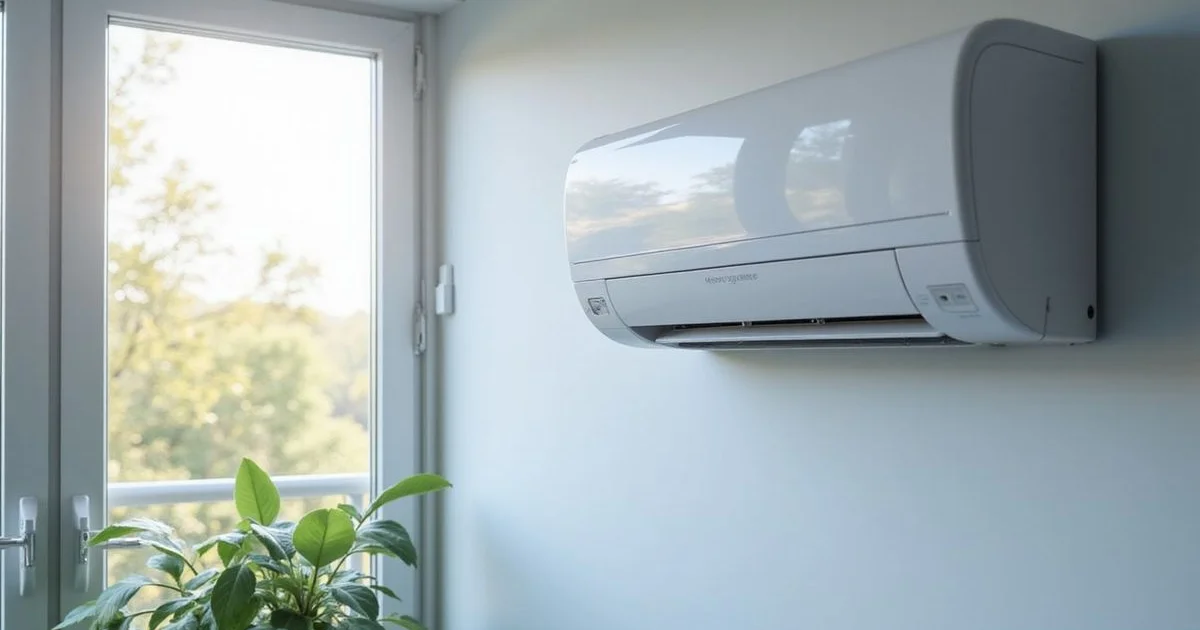
Understanding why your aircon has condensation & how to stop it is the single most important step in preventing a small water droplet from destroying your expensive flooring.
We founded Billy Aircon in 2003 with a team of five, and today our 26 technicians see these preventable leaks across Singapore daily. Local cooling systems are constantly fighting against extreme tropical weather.
The reality is that ignoring early warning signs and skipping professional aircon servicing always leads to costly property damage. Our team will break down the specific mechanical causes of this moisture. Let’s look at the data and outline the exact steps you need to resolve the dripping for good.
Understanding Why Your Aircon Has Condensation & How to Stop It
Moisture forms naturally when warm, humid room air makes contact with a significantly colder surface. Inside your air conditioning unit, the evaporator coils act as that freezing surface. As the blower fan pulls air over these copper coils, airborne water vapour condenses into liquid and drips safely into the drain pan.
This basic dehumidification process is exactly how your system makes the room feel crisp and comfortable. Our technicians consider this internal sweating completely normal for any standard residential unit.
The issue arises when water starts forming on the exterior casing, along the copper pipes, or across your ceiling. Those external droplets indicate a direct failure in either the insulation barrier or the internal airflow.
Common Causes of Excessive Condensation
Several distinct mechanical failures force your cooling system to produce more water than the drainage tray can handle.
1. Damaged or Missing Pipe Insulation
The suction line carries cold R32 refrigerant and often drops to temperatures between 5 and 10 degrees Celsius. Without thick insulation, the surrounding warm air condenses on the cold copper instantly. You will quickly spot water dripping along the trunking between the indoor and outdoor units.
Our installers frequently notice that standard 3/8-inch foam is insufficient for humid local conditions. Upgrading your materials provides immediate, verifiable benefits:
- Thicker barrier: Singapore industry standards recommend 1/2-inch (12.7mm) Armaflex to completely stop surface moisture.
- Better material: Class 0 black rubber resists warm, wet air much longer than basic polyethylene foam.
- Stronger pipes: Pairing this insulation with SWG22 copper pipes (0.71mm thickness) prevents pressure leaks.
- Instant results: Replacing degraded foam stops the dripping immediately.
2. Dirty Filters Restricting Airflow
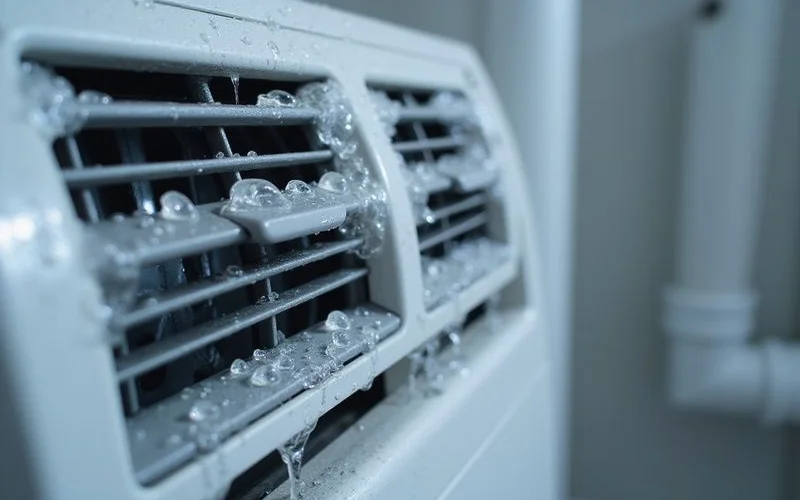
Dust and debris easily clog filters when you run your system daily in a busy household. This blockage prevents sufficient room air from passing over the cooling coils to exchange heat. The resulting lack of heat transfer causes the internal temperature to plummet below freezing.
We see thick layers of solid ice form across the coils as a direct result of this suffocation. When the compressor cycles off, this heavy ice melts much faster than the drainage system can channel away. Washing your filters every two weeks prevents this specific chain reaction entirely.
3. Low Refrigerant
Insufficient gas levels force the evaporator coils to operate at abnormally low temperatures. This pressure drop creates excessive sweating and severe ice formation inside the blower unit. You might notice poor cooling performance long before the water actually starts dripping down your wall.
Our service teams always check the system pressure using digital manifolds when ice appears on the copper joints. Securing a proper gas top-up restores the correct operating pressure instantly. Your technician must also locate and repair any underlying leaks to prevent the issue from returning next month.
4. Blocked Drainage
Condensation naturally flows out through a standard 16mm PVC drainage pipe. Dirt, airborne dust, and algae combine inside this dark, damp tube to form a thick jelly-like blockage. The trapped water simply backs up into the internal pan until it spills over the plastic edge.
“A clear 16mm PVC drainage pipe is your primary defence against internal pan overflows.”
This overflow eventually runs down your walls and ruins your expensive flooring. Regular servicing blasts high-pressure water through the line to clear these biological blockages. Our maintenance teams consider a clear exit path essential for heavy daily usage in tropical climates.
5. High Indoor Humidity
Recent 2026 data from the National Environment Agency shows Singapore maintains a staggering average relative humidity that frequently spikes past 90 percent during early mornings. Opening windows while the compressor runs forces the system to pull massive amounts of outdoor moisture inside. The machine simply cannot process this continuous intake fast enough.
We recommend keeping all doors and windows sealed tight to maintain efficiency. Indoor activities like boiling soup or taking hot showers also spike local humidity levels drastically. Running the bathroom exhaust fan actively extracts this steam before it reaches your main living spaces.
6. Temperature Set Too Low
Many users mistakenly set their remotes to 18 degrees Celsius hoping for faster cooling. This extreme setting turns the plastic vents into freezing surfaces that attract immediate condensation. The room air simply turns to liquid the moment it touches the chilled louvres.
Our advice aligns with the National Environment Agency recommendations and the Go 25 national movement. Adjusting your thermostat to the 24 to 25-degree range provides excellent, verifiable benefits:
- Maintains comfortable cooling without freezing the interior components.
- Prevents exterior sweating and random water drips across your desk.
- Saves you an estimated $13 annually for every degree raised.
7. Faulty Thermistor
A broken thermistor fails to read the actual room climate accurately. This tiny sensor might register a warm room even when the space is already freezing. The compressor continues running non-stop, driving the coil temperature down until heavy ice forms.
This hardware failure creates the exact same dripping symptoms as a severe gas shortage. Our electricians replace this inexpensive electronic sensor to resolve the overcooling instantly. Accurate temperature tracking keeps the compressor cycling normally and prevents unnecessary ice buildup.
How to Stop Condensation Problems
Taking immediate action prevents minor sweating from turning into a major water leak. A quick response protects your property from expensive secondary damage.
Quick Fixes You Can Implement Today
You can handle several basic maintenance tasks without specialised tools or training.
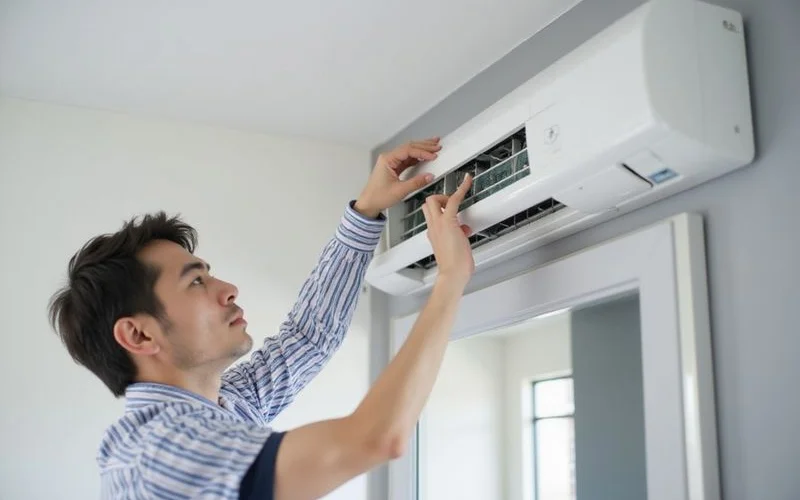
- Sanitise the filters: Pull out the mesh screens, rinse them under warm water, and dry them fully before reinserting.
- Optimise the thermostat: Raise the target temperature to the recommended 25 degrees Celsius.
- Seal the environment: Shut all windows and doors tightly to block humid drafts from entering.
- Extract indoor steam: Turn on mechanical exhaust fans during hot showers or active cooking.
- Inspect the trunking: Look closely at the foam wrapped around your copper pipes for visible cracks.
Fixes That Require a Professional Technician
Certain internal components require specialised diagnostic tools and safe handling procedures. We deploy advanced equipment to resolve these deeper mechanical issues effectively.
- Upgrade the insulation: Technicians install thicker, 1/2-inch Armaflex tubing to shield the cold lines from humid air.
- Clear the drainage track: High-pressure vacuums remove deep algae blockages from the PVC exit pipes.
- Restore the pressure: Proper gauges determine exact refrigerant shortages before adding a fresh charge.
- Calibrate the sensors: Faulty thermistor units are swapped out to restore accurate climate reading.
- Execute a chemical wash: Deep cleaning chemicals dissolve stubborn grime from the aluminium fins.
The Humidity Factor in Singapore
Our local climate presents a massive, year-round challenge for any mechanical cooling equipment. The northeast monsoon season from November to January pushes daily humidity levels past 90 percent consistently. Your system works overtime during these wet months just to strip heavy moisture from your living space.
We highly recommend utilising your remote’s dry mode during these sticky evening hours. This specific function operates the compressor in short bursts while keeping the blower fan at a very low speed. This deliberate pacing prioritises pulling water vapour out of the air rather than drastically dropping the temperature.
Here is a quick comparison showing how these settings manage indoor climates:
| Feature Focus | Standard Cool Mode | Specialised Dry Mode |
|---|---|---|
| Primary Goal | Dropping room temperature quickly | Extracting airborne water vapour |
| Compressor Action | Runs continuously until target is met | Cycles on and off intermittently |
| Fan Speed | High or Auto | Locked to a low speed |
| Energy Usage | Higher power consumption | Lower total electricity draw |
| Best Used When | The room is hot and sunny | The weather is rainy and sticky |
Achieving an indoor humidity target of 50 to 60 percent prevents mould from colonising your walls. You can explore additional methods for reducing humidity at home to protect your furnishings.
When Condensation Indicates a Bigger Problem
Wiping down a sweaty plastic casing every few days is not a sustainable long-term strategy. Persistent dripping that continues after a basic filter wash points directly to a failing internal component. Ignoring this steady leak practically guarantees severe property damage.
Prolonged moisture exposure creates several expensive financial and legal headaches in Singapore:
- Costly repairs: Fixing water-damaged laminate flooring easily costs between $150 and $750, plus a $250 dismantling fee.
- Health hazards: Aggressive black mould spreads rapidly across damp false ceilings.
- Safety risks: Water seeping into nearby electrical sockets creates an immediate fire hazard.
- Neighbour disputes: A 2026 parliamentary report revealed HDB received 240 complaints in 2025 specifically regarding condensation and mould caused by neighbours.
Our specialists deal with these exact scenarios across local estates every single day. Professional diagnostics reveal the exact root cause quickly so you do not have to keep laying down dry towels. If you are still researching why your aircon has condensation & how to stop it, reach out to Billy Aircon to book a service visit today.
Billy Aircon Team
Technical Writers
The Billy Aircon editorial team draws from our 26-strong workforce of experienced aircon technicians.